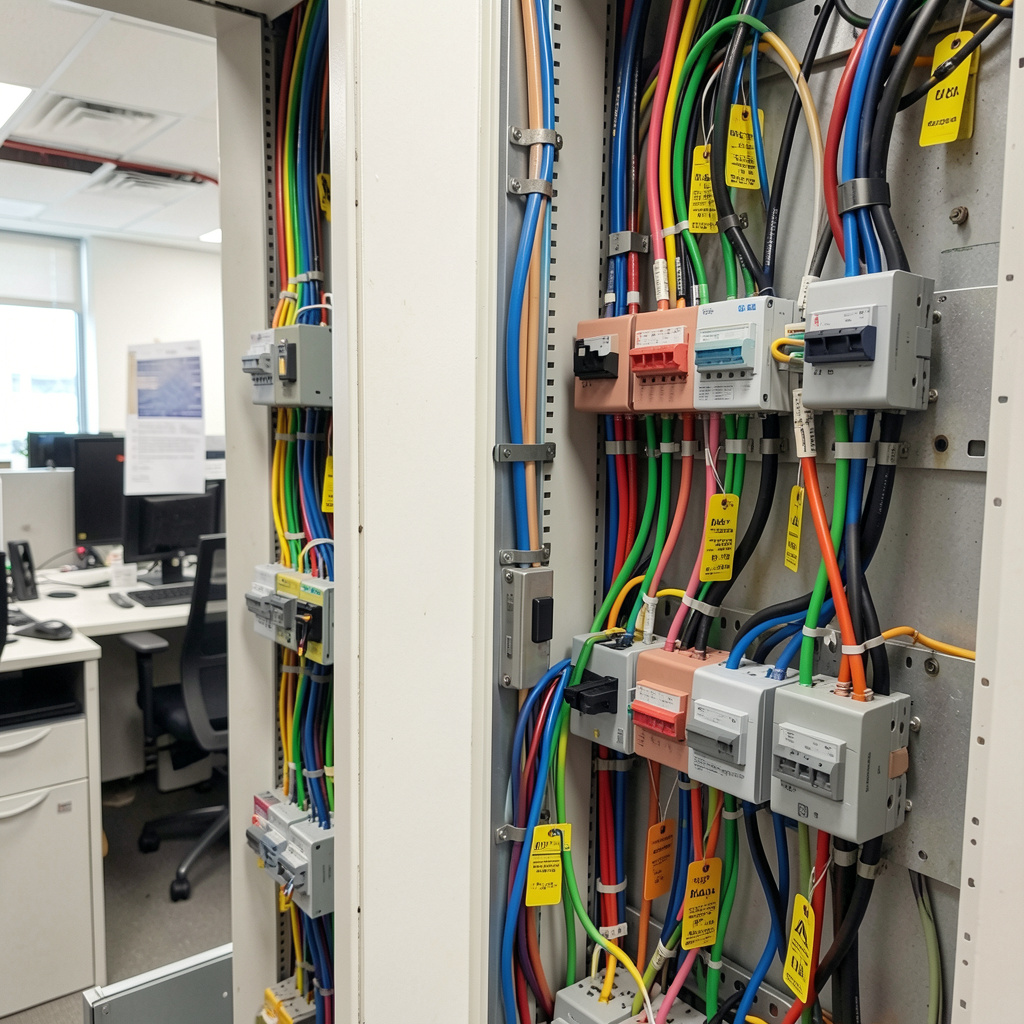
Commercial Rewiring: When Does a Commercial Building Need Rewiring?
Commercial rewiring is the process of replacing or substantially renewing the fixed electrical wiring within a business premises. It can become necessary when an electrical installation is deteriorated, unsuitable for the building’s current use, or requires significant changes to meet present electrical requirements.
For a business owner or property manager, the important question is not simply how old the wiring is. Its condition, design, usage, alterations and electrical demand all matter.
This guide explains when commercial rewiring may be needed, the warning signs to look for, what the process involves and how long it can take.
What Is Commercial Rewiring?
Commercial rewiring involves replacing electrical cables and associated components within a commercial installation.
Depending on the building and project, this may involve:
- Fixed wiring and cables
- Socket and switch circuits
- Lighting circuits
- Distribution boards
- Circuit protection
- Earthing and bonding
- Connections and accessories
The exact scope depends on the condition of the existing installation and the requirements of the premises.
Electrical installations in commercial and industrial settings are covered by relevant requirements including BS 7671, the IET Wiring Regulations. NAPIT identifies BS 7671 as the standard used for the design, installation, inspection, testing and maintenance of electrical installations.
When Does a Commercial Building Need Rewiring?
There is no single age at which every commercial property needs rewiring. Instead, an electrical installation should be assessed according to its condition and suitability.
1. The Wiring Is Deteriorated
Damaged insulation, deteriorated cables, loose connections or other defects can indicate that parts of an installation require attention.
A professional inspection can determine whether individual repairs are sufficient or whether more extensive work is appropriate.
2. The Electrical System Has Been Heavily Modified
Commercial premises often change over time. New lighting, machinery, office equipment, kitchen equipment or additional circuits may have been added to an existing installation.
If modifications have accumulated without a coordinated assessment of the wider system, the installation may need reviewing.
3. Electrical Demand Has Increased
A business that uses substantially more electrical equipment than when the installation was originally designed may need changes to its electrical infrastructure.
For example, converting a storage area into an office, adding commercial equipment or installing new machinery can change the electrical requirements of the building.
Where additional capacity is required, commercial electrical installations in Manchester can include appropriate installation and distribution work.
4. Persistent Electrical Problems Occur
Repeated tripping, flickering lights, overheating, burning smells or unexplained power interruptions can indicate electrical problems.
These symptoms do not automatically mean the entire building needs rewiring. They should first be investigated so the actual cause can be established.
Signs a Commercial Building Needs Rewiring
Some signs a commercial building needs rewiring are easy to notice, while others may only become apparent during inspection and testing.
Look out for:
- Frequent circuit breaker trips
- Flickering or unreliable lighting
- Burning smells
- Discoloured sockets or accessories
- Warm electrical equipment
- Damaged cables or insulation
- Repeated electrical faults
- Circuits that regularly become overloaded
- An installation that has undergone extensive unplanned alterations
Visible damage or signs of overheating should be treated seriously and investigated promptly.
HSE guidance notes that electrical systems and equipment must be maintained so far as is reasonably practicable to prevent danger, and that BS 7671 is widely recognised as a relevant code of practice for electrical installations.
How Often Does Commercial Wiring Need Replacing?
There is no universal replacement interval for commercial wiring.
The appropriate approach is to assess the condition and suitability of the installation rather than replacing wiring simply because it has reached a particular age.
Factors include:
- Condition of cables and accessories
- Type and use of the premises
- Electrical loading
- Previous alterations
- Environmental conditions
- Inspection and testing results
- Changes to the building or business
An older installation can sometimes remain in service if it is safe and suitable, while a newer installation may require remedial work if defects or damage are identified.
What Is the Commercial Rewiring Process?
A typical commercial rewiring process involves several stages.
1. Initial Assessment
The property’s electrical requirements, existing installation and any known problems are reviewed.
2. Inspection and Testing
Appropriate inspection and testing help identify defects and determine the condition of the existing installation.
Where a formal condition assessment is appropriate, a Commercial EICR in Manchester can provide documented findings about the installation’s condition.
3. Rewiring Plan
If significant work is required, the project can be planned around the building’s layout, electrical requirements and business operations.
4. Installation
Cables, circuits and associated electrical components are replaced or upgraded according to the agreed scope.
Commercial work needs careful planning because the premises may need to remain operational during the project.
5. Inspection, Testing and Certification
Completed electrical work should be appropriately inspected, tested and documented.
BS 7671 covers electrical installation design, erection, inspection and testing, while NAPIT’s current guidance also covers testing and certification.
How Long Does Commercial Rewiring Take?
The time required depends heavily on the property and the scope of work.
A small commercial unit with straightforward wiring may require considerably less time than a multi-floor office, warehouse or industrial premises.
Factors affecting the duration include:
- Building size
- Number of circuits
- Accessibility of existing wiring
- Number of floors
- Type of business
- Required electrical upgrades
- Amount of testing and remedial work
- Whether the business needs to remain operational
A detailed site assessment is therefore more useful than giving every commercial property the same estimated timeframe.
Can a Business Stay Open During Rewiring?
Sometimes, yes.
Commercial rewiring can potentially be phased so that different areas are worked on at different times. This may help reduce disruption, particularly for offices, retail premises and other businesses that need to continue operating.
The practical approach depends on the electrical system, building layout and nature of the business.
If ongoing maintenance and electrical issues are a concern, commercial electrical maintenance in Manchester can help businesses plan electrical maintenance, repairs and testing around their operational requirements.
Commercial Rewiring Requirements
Commercial electrical work needs to take account of the applicable electrical and workplace safety requirements.
BS 7671 is widely used for electrical installations in the UK, including commercial and industrial settings. NAPIT’s current information also distinguishes non-domestic electrical work under its Electrotechnical Assessment Specification (EAS).
The exact requirements depend on the type of premises, electrical work being undertaken and applicable legislation.
This is why commercial rewiring should be designed, installed, inspected and tested by appropriately competent electrical professionals.
Rewiring vs Repairing: Which Is Needed?
A fault does not automatically mean the entire building needs rewiring.
For example:
Localised damaged cable → repair or replacement may be appropriate
Whereas:
Widespread deterioration + unsuitable circuits + extensive defects → more comprehensive electrical work may be required
The correct solution should be based on inspection findings and the condition of the installation rather than simply choosing the most extensive option.
For additional background, see our guide to old wiring warning signs and our article on electrical hazards in UK properties.
Frequently Asked Questions
What are the main signs a commercial building needs rewiring?
Frequent electrical faults, damaged wiring, overheating, repeated tripping, burning smells and extensive deterioration can indicate that an installation needs further assessment.
How often does commercial wiring need replacing?
There is no fixed replacement period that applies to every commercial property. The condition, usage, electrical demand and inspection results should determine whether replacement is necessary.
Does an EICR mean a building needs rewiring?
No. An EICR identifies the condition of an electrical installation and records relevant observations. A finding does not automatically mean the entire installation requires rewiring.
How long does commercial rewiring take?
It depends on the building, number of circuits, accessibility, electrical requirements and scope of work. Larger or occupied premises generally require more planning and coordination.
Is commercial rewiring covered by BS 7671?
BS 7671 is the principal UK standard for electrical installations and applies to relevant commercial and industrial installations. The exact requirements depend on the installation and work being undertaken.
Conclusion
Commercial rewiring is not determined by the age of a building alone. The condition of the wiring, electrical demand, previous alterations, building use and inspection findings all help determine whether rewiring is appropriate.
If a commercial property has persistent electrical faults, deteriorated wiring or changing electrical requirements, a professional assessment can establish whether repair, partial rewiring or more extensive electrical work is necessary.
This approach helps avoid unnecessary work while ensuring genuine electrical problems are properly addressed.
Commercial Rewiring: When Does a Commercial Building Need Rewiring?
Commercial rewiring is the process of replacing or substantially renewing the fixed electrical wiring within a business premises. It can become necessary when an electrical installation is deteriorated, unsuitable for the building’s current use, or requires significant changes to meet present electrical requirements.
For a business owner or property manager, the important question is not simply how old the wiring is. Its condition, design, usage, alterations and electrical demand all matter.
This guide explains when commercial rewiring may be needed, the warning signs to look for, what the process involves and how long it can take.
What Is Commercial Rewiring?
Commercial rewiring involves replacing electrical cables and associated components within a commercial installation.
Depending on the building and project, this may involve:
- Fixed wiring and cables
- Socket and switch circuits
- Lighting circuits
- Distribution boards
- Circuit protection
- Earthing and bonding
- Connections and accessories
The exact scope depends on the condition of the existing installation and the requirements of the premises.
Electrical installations in commercial and industrial settings are covered by relevant requirements including BS 7671, the IET Wiring Regulations. NAPIT identifies BS 7671 as the standard used for the design, installation, inspection, testing and maintenance of electrical installations.
When Does a Commercial Building Need Rewiring?
There is no single age at which every commercial property needs rewiring. Instead, an electrical installation should be assessed according to its condition and suitability.
1. The Wiring Is Deteriorated
Damaged insulation, deteriorated cables, loose connections or other defects can indicate that parts of an installation require attention.
A professional inspection can determine whether individual repairs are sufficient or whether more extensive work is appropriate.
2. The Electrical System Has Been Heavily Modified
Commercial premises often change over time. New lighting, machinery, office equipment, kitchen equipment or additional circuits may have been added to an existing installation.
If modifications have accumulated without a coordinated assessment of the wider system, the installation may need reviewing.
3. Electrical Demand Has Increased
A business that uses substantially more electrical equipment than when the installation was originally designed may need changes to its electrical infrastructure.
For example, converting a storage area into an office, adding commercial equipment or installing new machinery can change the electrical requirements of the building.
Where additional capacity is required, commercial electrical installations in Manchester can include appropriate installation and distribution work.
4. Persistent Electrical Problems Occur
Repeated tripping, flickering lights, overheating, burning smells or unexplained power interruptions can indicate electrical problems.
These symptoms do not automatically mean the entire building needs rewiring. They should first be investigated so the actual cause can be established.
Signs a Commercial Building Needs Rewiring
Some signs a commercial building needs rewiring are easy to notice, while others may only become apparent during inspection and testing.
Look out for:
- Frequent circuit breaker trips
- Flickering or unreliable lighting
- Burning smells
- Discoloured sockets or accessories
- Warm electrical equipment
- Damaged cables or insulation
- Repeated electrical faults
- Circuits that regularly become overloaded
- An installation that has undergone extensive unplanned alterations
Visible damage or signs of overheating should be treated seriously and investigated promptly.
HSE guidance notes that electrical systems and equipment must be maintained so far as is reasonably practicable to prevent danger, and that BS 7671 is widely recognised as a relevant code of practice for electrical installations.
How Often Does Commercial Wiring Need Replacing?
There is no universal replacement interval for commercial wiring.
The appropriate approach is to assess the condition and suitability of the installation rather than replacing wiring simply because it has reached a particular age.
Factors include:
- Condition of cables and accessories
- Type and use of the premises
- Electrical loading
- Previous alterations
- Environmental conditions
- Inspection and testing results
- Changes to the building or business
An older installation can sometimes remain in service if it is safe and suitable, while a newer installation may require remedial work if defects or damage are identified.
What Is the Commercial Rewiring Process?
A typical commercial rewiring process involves several stages.
1. Initial Assessment
The property’s electrical requirements, existing installation and any known problems are reviewed.
2. Inspection and Testing
Appropriate inspection and testing help identify defects and determine the condition of the existing installation.
Where a formal condition assessment is appropriate, a Commercial EICR in Manchester can provide documented findings about the installation’s condition.
3. Rewiring Plan
If significant work is required, the project can be planned around the building’s layout, electrical requirements and business operations.
4. Installation
Cables, circuits and associated electrical components are replaced or upgraded according to the agreed scope.
Commercial work needs careful planning because the premises may need to remain operational during the project.
5. Inspection, Testing and Certification
Completed electrical work should be appropriately inspected, tested and documented.
BS 7671 covers electrical installation design, erection, inspection and testing, while NAPIT’s current guidance also covers testing and certification.
How Long Does Commercial Rewiring Take?
The time required depends heavily on the property and the scope of work.
A small commercial unit with straightforward wiring may require considerably less time than a multi-floor office, warehouse or industrial premises.
Factors affecting the duration include:
- Building size
- Number of circuits
- Accessibility of existing wiring
- Number of floors
- Type of business
- Required electrical upgrades
- Amount of testing and remedial work
- Whether the business needs to remain operational
A detailed site assessment is therefore more useful than giving every commercial property the same estimated timeframe.
Can a Business Stay Open During Rewiring?
Sometimes, yes.
Commercial rewiring can potentially be phased so that different areas are worked on at different times. This may help reduce disruption, particularly for offices, retail premises and other businesses that need to continue operating.
The practical approach depends on the electrical system, building layout and nature of the business.
If ongoing maintenance and electrical issues are a concern, commercial electrical maintenance in Manchester can help businesses plan electrical maintenance, repairs and testing around their operational requirements.
Commercial Rewiring Requirements
Commercial electrical work needs to take account of the applicable electrical and workplace safety requirements.
BS 7671 is widely used for electrical installations in the UK, including commercial and industrial settings. NAPIT’s current information also distinguishes non-domestic electrical work under its Electrotechnical Assessment Specification (EAS).
The exact requirements depend on the type of premises, electrical work being undertaken and applicable legislation.
This is why commercial rewiring should be designed, installed, inspected and tested by appropriately competent electrical professionals.
Rewiring vs Repairing: Which Is Needed?
A fault does not automatically mean the entire building needs rewiring.
For example:
Localised damaged cable → repair or replacement may be appropriate
Whereas:
Widespread deterioration + unsuitable circuits + extensive defects → more comprehensive electrical work may be required
The correct solution should be based on inspection findings and the condition of the installation rather than simply choosing the most extensive option.
For additional background, see our guide to old wiring warning signs and our article on electrical hazards in UK properties.
Frequently Asked Questions
What are the main signs a commercial building needs rewiring?
Frequent electrical faults, damaged wiring, overheating, repeated tripping, burning smells and extensive deterioration can indicate that an installation needs further assessment.
How often does commercial wiring need replacing?
There is no fixed replacement period that applies to every commercial property. The condition, usage, electrical demand and inspection results should determine whether replacement is necessary.
Does an EICR mean a building needs rewiring?
No. An EICR identifies the condition of an electrical installation and records relevant observations. A finding does not automatically mean the entire installation requires rewiring.
How long does commercial rewiring take?
It depends on the building, number of circuits, accessibility, electrical requirements and scope of work. Larger or occupied premises generally require more planning and coordination.
Is commercial rewiring covered by BS 7671?
BS 7671 is the principal UK standard for electrical installations and applies to relevant commercial and industrial installations. The exact requirements depend on the installation and work being undertaken.
Conclusion
Commercial rewiring is not determined by the age of a building alone. The condition of the wiring, electrical demand, previous alterations, building use and inspection findings all help determine whether rewiring is appropriate.
If a commercial property has persistent electrical faults, deteriorated wiring or changing electrical requirements, a professional assessment can establish whether repair, partial rewiring or more extensive electrical work is necessary.
This approach helps avoid unnecessary work while ensuring genuine electrical problems are properly addressed.
Leave a Reply