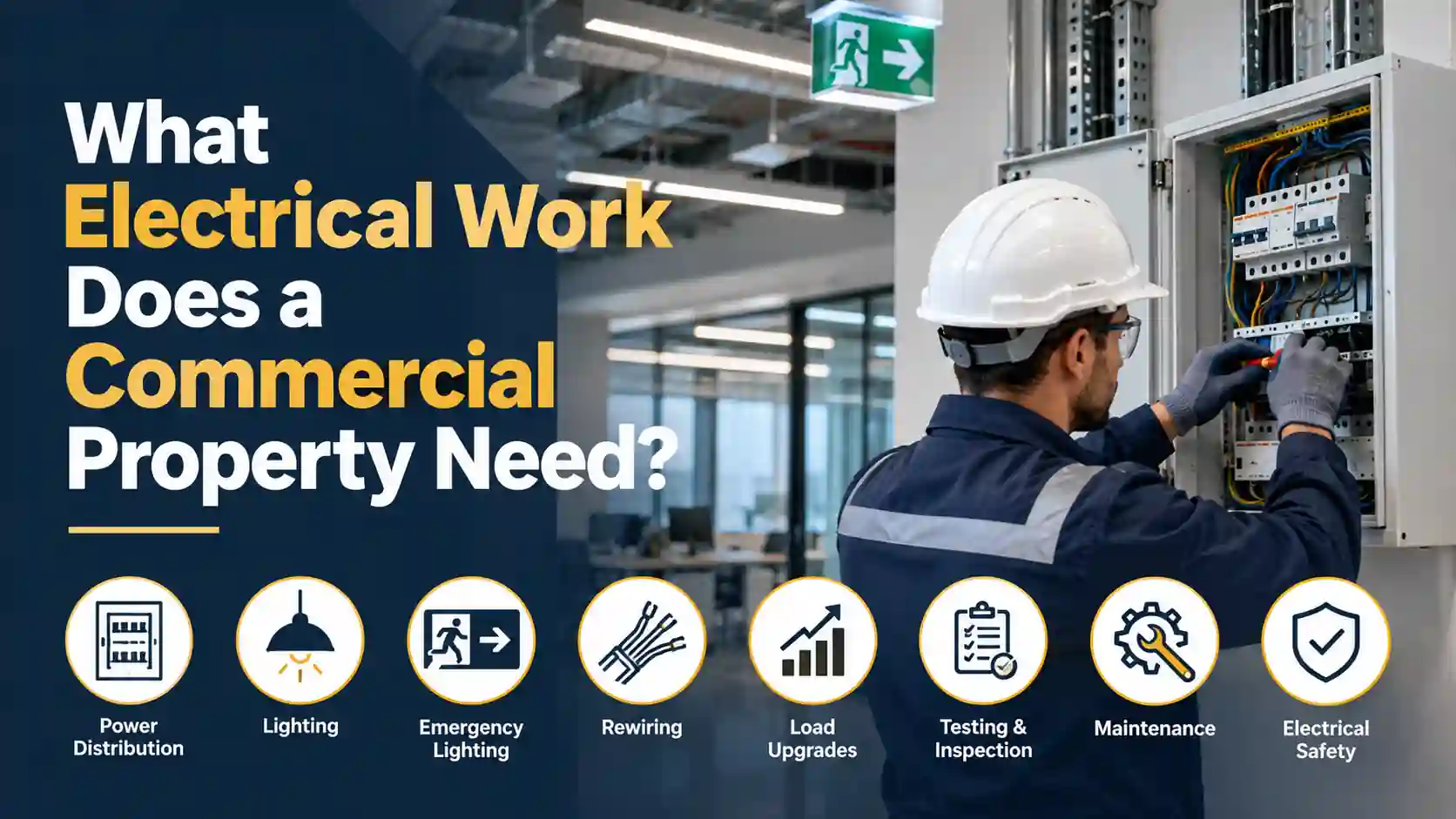
Every commercial property needs a safe and suitable electrical installation, but the work required depends on the building’s use, equipment, electrical demand and the condition of its existing system. An office, warehouse, restaurant or workshop may need different upgrades, repairs or maintenance. This guide explains the common electrical requirements, when they may need attention, and how to recognise problems before they affect the property.
Quick Overview: Electrical Work a Commercial Property May Need
| Electrical Area | What It Covers | Why It Matters |
|---|---|---|
| Power distribution | Distribution boards, circuits and power supplies | Delivers electricity safely around the property |
| Consumer units & distribution boards | Protective devices, circuit control and distribution | Helps protect circuits and electrical equipment |
| Commercial lighting | Internal, external and specialist lighting | Provides suitable lighting for staff, customers and work areas |
| Emergency lighting | Emergency escape and backup lighting | Helps people move safely if normal lighting fails |
| Commercial rewiring | Replacement or improvement of unsuitable wiring | Addresses ageing, damaged or inadequate wiring |
| Electrical load upgrades | Increasing available electrical capacity | Supports additional equipment or increased demand |
| Electrical testing & inspection | Inspection, testing and identification of defects | Helps identify electrical problems and safety concerns |
| Electrical maintenance | Repairs, checks and ongoing electrical work | Helps keep the installation suitable for continued use |
| Electrical safety improvements | Correcting defects and improving protection | Reduces risks associated with electrical faults |
1. Electrical Installation and Power Distribution
The core of most commercial electrical systems is the distribution network that takes electricity from the incoming supply and distributes it safely to individual circuits and equipment.
This can include:
- Distribution boards
- Sub-distribution boards
- Power circuits
- Socket circuits
- Dedicated equipment supplies
- Three-phase distribution
- Circuit protection
- Earthing and bonding
A well-planned distribution system should provide suitable capacity for the building’s current electrical demand while considering foreseeable changes.
Why Does Power Distribution Matter?
Commercial buildings often have considerably more electrical equipment than a typical home.
An office might have computers, servers, printers, kitchen equipment and air-conditioning systems. A workshop could have machinery and high-power tools. A restaurant may have commercial cooking equipment, refrigeration and extraction systems.
If the distribution system does not adequately accommodate the electrical load, businesses can experience repeated tripping, overheating, voltage problems or insufficient capacity.
2. Consumer Units and Distribution Boards
Distribution boards and consumer units contain protective devices that help protect electrical circuits against conditions such as overloads and short circuits. Depending on the installation, RCDs or RCBOs may also provide additional protection.
A commercial installation may require more than one distribution board, particularly where a building has multiple floors, separate areas or substantial electrical demand.
Warning signs that a distribution arrangement may need attention include:
- Frequent circuit tripping
- Overheating
- Damaged components
- Unusual smells or sounds
- Insufficient circuit capacity
- Repeated electrical faults
- Significant changes to the building’s electrical requirements
You can learn more about commercial consumer units and distribution boards and the circumstances in which existing equipment may need inspection, replacement or upgrading.
3. Commercial Lighting
Lighting is an essential part of almost every commercial property. It needs to provide suitable illumination for the activities taking place while also supporting safety and efficient operation.
Commercial lighting can include:
- Office lighting
- Retail lighting
- Warehouse lighting
- Industrial lighting
- External lighting
- Emergency lighting
- Security lighting
- LED lighting systems
The appropriate solution depends on the building and how each area is used.
For example, a warehouse may require high-level lighting across large areas, while an office may need more controlled illumination around workstations.
Businesses considering a new lighting system or upgrading an existing one can explore commercial lighting installation for further information.
4. Emergency Lighting
Emergency lighting is different from normal everyday lighting.
Its purpose is to provide illumination when the normal lighting supply fails, helping people move safely through relevant areas and locate exits or safety equipment.
Commercial properties may have specific emergency-lighting requirements depending on their layout, occupancy and use.
Emergency lighting should therefore be properly designed, installed, tested and maintained rather than treated simply as another set of light fittings.
5. Commercial Rewiring
Not every older commercial property needs a complete rewire. However, the condition of the existing installation needs to be considered when wiring has deteriorated, electrical requirements have changed or extensive alterations have taken place.
Potential warning signs include:
- Damaged cable insulation
- Frequent electrical faults
- Persistent circuit tripping
- Overheating
- Outdated or unsuitable electrical arrangements
- Extensive previous modifications
- Insufficient circuits for the property’s current use
A professional assessment can determine whether the appropriate solution is a local repair, partial replacement, circuit upgrades or more extensive rewiring.
If the installation has become unsuitable or significantly deteriorated, see the information on commercial rewiring in Manchester.
6. Electrical Load Upgrades
One of the most common reasons a commercial property’s electrical requirements change is increased electrical demand.
A business may add:
- New machinery
- Air-conditioning
- Commercial kitchen equipment
- EV charging equipment
- Additional computers and IT equipment
- Larger refrigeration systems
- New production equipment
- Additional lighting
- Building extensions
Adding equipment does not automatically mean the property’s supply needs upgrading. The existing capacity should first be assessed.
If the required demand exceeds what the existing electrical infrastructure can appropriately support, a commercial electrical load upgrade may need to be considered.
Why Is Electrical Load Assessment Important?
Simply adding more circuits does not necessarily solve a capacity problem.
The overall installation needs to be considered, including the incoming supply, distribution equipment, circuit loading and the characteristics of the connected equipment.
This is particularly important when a business is expanding or introducing high-power equipment.
7. Electrical Testing and Inspection
Regular inspection and testing are important parts of managing a commercial electrical installation.
Testing can help identify problems that may not be obvious during a normal visual inspection, including defects affecting wiring, protective devices, connections or other parts of the installation.
An inspection can help answer questions such as:
- Is the installation in suitable condition?
- Are there visible defects?
- Are circuits appropriately protected?
- Have previous modifications introduced problems?
- Are there issues requiring remedial work?
The frequency and type of inspection should be appropriate to the installation, its use and the relevant requirements.
An inspection does not automatically mean that a property needs rewiring or major upgrades. The findings should determine what action, if any, is necessary.
8. Electrical Maintenance for Commercial Properties
Electrical work does not end once an installation has been completed.
Ongoing electrical maintenance for commercial properties helps businesses identify developing problems and keep electrical equipment and installations in suitable condition.
Maintenance may involve:
- Visual inspections
- Testing
- Repairing damaged equipment
- Replacing defective components
- Checking protective devices
- Addressing recurring faults
- Maintaining lighting systems
- Reviewing electrical equipment after building changes
A maintenance programme should reflect the type of premises and the electrical equipment used there.
For example, an electrical system in a warehouse with machinery may require a different maintenance approach from a small office.
9. Commercial Electrical Safety Requirements
Electrical safety should be considered throughout the life of a commercial installation, from design and installation through to inspection, maintenance and modification.
Important areas can include:
Circuit Protection
Circuits need suitable protective arrangements for the installation and equipment being supplied.
Earthing and Bonding
Appropriate earthing and bonding arrangements form an important part of electrical safety.
Equipment Condition
Damaged sockets, switches, cables, distribution equipment or other electrical components should not simply be ignored.
Safe Working
Electrical work should be carried out by people with appropriate competence for the work involved.
In the UK, BS 7671 provides requirements for electrical installations, while workplace electrical safety is also addressed by the Health and Safety Executive.
For businesses wanting to understand the contractor side of commercial electrical work, you can also see information about a NAPIT-approved electrical contractor in Manchester.
10. Electrical Work for Different Types of Commercial Property
The electrical requirements of a property depend heavily on its purpose.
Offices
An office may require:
- General and task lighting
- Socket circuits
- IT and equipment supplies
- Data-related electrical infrastructure
- Emergency lighting
- Kitchen facilities
- Heating and cooling supplies
Retail Units
Retail premises may require:
- Display lighting
- General lighting
- Emergency lighting
- Socket circuits
- Signage supplies
- Security-related electrical systems
- Equipment supplies
Warehouses
Warehouses can require:
- High-level lighting
- Emergency lighting
- Socket circuits
- Machinery supplies
- Distribution systems
- External lighting
- Charging facilities
Restaurants and Commercial Kitchens
These premises can have substantially different electrical demands because of equipment such as:
- Ovens
- Hobs
- Refrigeration
- Freezers
- Dishwashers
- Extraction equipment
- Food preparation equipment
The electrical installation needs to be designed around the actual equipment and operating requirements.
Workshops and Industrial Premises
Workshops may require dedicated supplies for machinery, three-phase equipment, distribution systems and other high-demand electrical loads.
This is one reason why commercial electrical requirements should be assessed according to the property’s actual use rather than applying the same specification to every business.
How Do You Know What Electrical Work Your Property Needs?
A useful starting point is to look at three things: the building, the electrical installation and the business’s requirements.
1. Assess the Existing Installation
Consider its age, condition, previous modifications and known electrical problems.
2. Identify Current Electrical Demand
List major electrical equipment and consider how much power the business currently requires.
3. Consider Future Changes
Think about planned machinery, additional offices, extensions, air-conditioning, EV charging or other equipment.
4. Investigate Existing Problems
Repeated tripping, overheating, flickering, damaged equipment or unexplained outages should be investigated rather than treated as normal.
5. Obtain Appropriate Professional Advice
A competent electrical professional can assess the installation and determine whether the property needs maintenance, repair, additional circuits, a load upgrade, rewiring or another form of electrical work.
For businesses in Manchester looking for professional help with their wider electrical requirements, see our Commercial Electrician Manchester service page.
Does Every Commercial Property Need the Same Electrical Work?
No.
A small office, retail unit, restaurant, warehouse and industrial building can have completely different electrical requirements.
For example, a small office might mainly need lighting, sockets and IT equipment, while a workshop could require three-phase supplies and dedicated circuits for machinery.
The right approach is therefore to assess the property’s:
Use → Electrical demand → Existing installation → Safety requirements → Future needs
This helps avoid both under-specifying an electrical installation and carrying out unnecessary work.
When Should a Commercial Electrical Installation Be Upgraded?
An upgrade may be worth investigating when the existing installation no longer adequately supports the property’s use.
Common triggers include:
- Business expansion
- New high-power equipment
- Building alterations
- Additional floors or areas
- Increased electrical demand
- Recurring electrical faults
- Deteriorated wiring
- Insufficient distribution capacity
- Changes to how the property is used
The appropriate solution might be a relatively small modification or a much larger electrical project. An assessment should establish the actual requirement.
A Practical Commercial Electrical Checklist
Before opening, refurbishing or expanding a commercial property, consider whether you have assessed:
- Incoming electrical supply
- Distribution boards
- Consumer units and protective devices
- Socket and power circuits
- Lighting
- Emergency lighting
- Electrical equipment
- Earthing and bonding
- Electrical load and available capacity
- Condition of existing wiring
- Inspection and testing requirements
- Maintenance arrangements
- Planned future electrical demand
This checklist is not a substitute for professional electrical assessment, but it can help property owners and managers identify areas that may need attention.
Frequently Asked Questions
What electrical work does a commercial property need?
It depends on the building and its use. Typical requirements can include power distribution, lighting, emergency lighting, sockets, circuit protection, earthing, electrical equipment supplies, testing and ongoing maintenance.
Does an old commercial building always need rewiring?
No. The age of the building alone does not determine whether rewiring is necessary. The condition, suitability and electrical requirements of the existing installation should be assessed.
Can adding new equipment require an electrical upgrade?
Yes, depending on the equipment and the property’s existing electrical capacity. High-demand equipment may require additional circuits, distribution changes or a load upgrade.
How often should commercial electrical systems be checked?
There is no single interval that applies to every commercial property. Inspection and testing should be appropriate to the installation, its use and the relevant requirements.
Who should carry out commercial electrical work?
Commercial electrical work should be undertaken by a suitably competent electrical professional with the appropriate experience and qualifications for the work involved.
Should I Use a NAPIT-Registered Electrician for Commercial Electrical Work?
Using a NAPIT-registered electrician or contractor can help businesses check that the electrical professional they hire has relevant qualifications and has been assessed against NAPIT’s registration requirements. Businesses can verify a contractor’s current registration through the NAPIT register before arranging electrical work.
Conclusion
Commercial properties do not all need the same electrical work. The right approach depends on the building’s use, electrical demand, existing installation, condition and planned changes. This may include new installations, lighting, testing, maintenance, rewiring, distribution changes or additional electrical capacity.
Assessing these factors helps businesses address genuine electrical needs without carrying out unnecessary work. If you need professional help assessing your property’s electrical requirements, you can learn more about a Commercial Electrician in Manchester and the electrical services available for commercial properties.
Leave a Reply