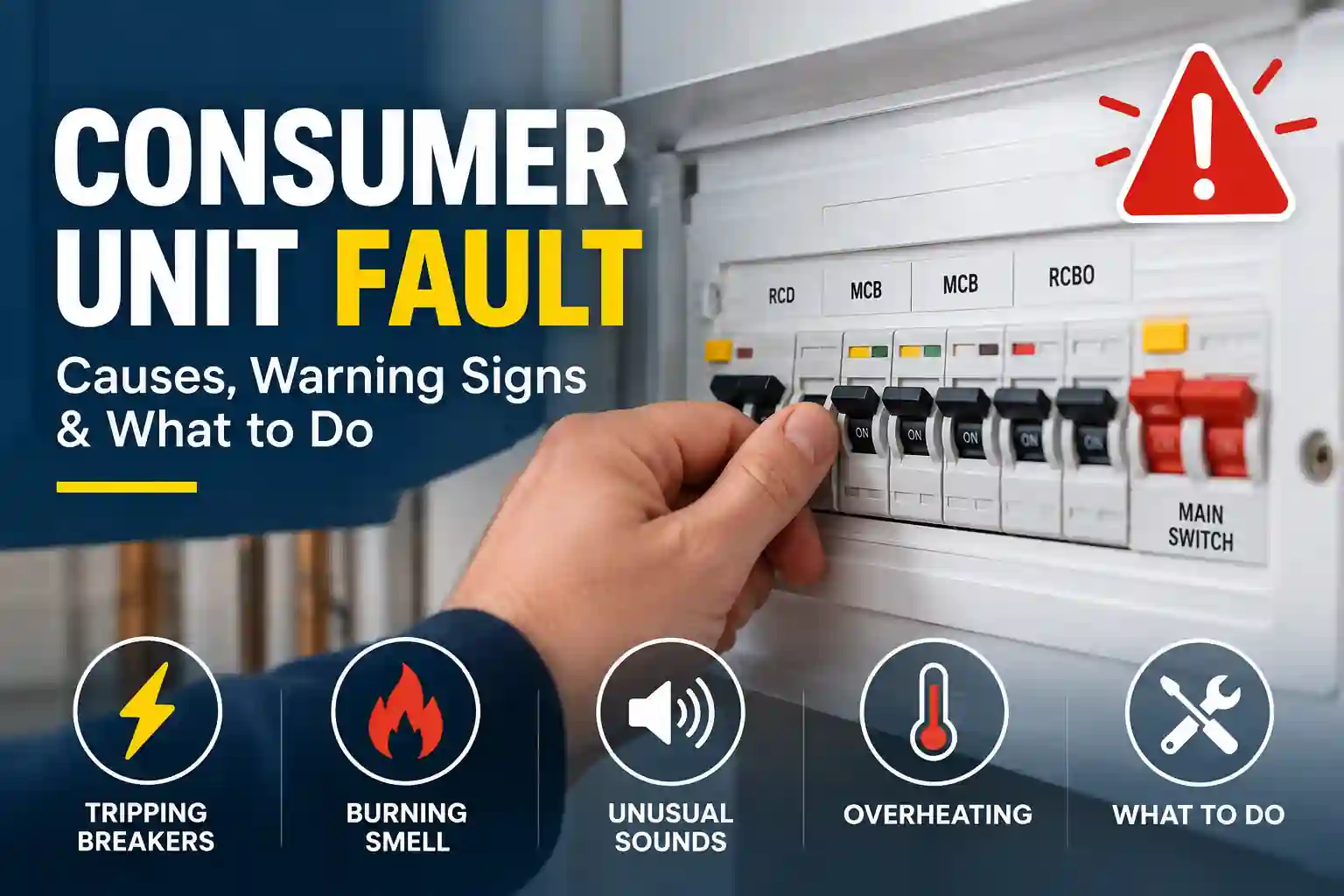
A consumer unit fault can cause repeated power cuts, tripping breakers, unusual noises or other electrical warning signs. However, a tripping consumer unit does not necessarily mean the consumer unit itself is faulty.
The underlying problem could be a faulty appliance, damaged wiring, an overloaded circuit or an issue with one of the protective devices. Understanding the symptoms can help you respond safely and know when professional investigation is needed.
Power Distribution & Consumer Units in Manchester >Consumer Unit Fault
What Is a Consumer Unit Fault?
A consumer unit, commonly called a fuse box, distributes electricity to the circuits in a property and provides protection through devices such as MCBs, RCDs and RCBOs.
A fault may originate inside the consumer unit or somewhere else on a connected circuit.
For example:
Faulty appliance → electrical fault → protective device trips
In this situation, the consumer unit may actually be working correctly by disconnecting the affected circuit.
Consumer Unit Fault Symptoms
The most common consumer unit fault symptoms include repeated tripping, unusual sounds, overheating and visible damage.
Repeated Tripping
If the same MCB, RCD or RCBO keeps switching off, there may be an unresolved fault on the circuit.
Occasional tripping can have different causes, but repeated or unexplained trips should be investigated rather than continually reset.
A Breaker Will Not Stay On
If a breaker trips immediately after being reset, the underlying fault may still be present.
Do not repeatedly force it back on. Continued tripping indicates that further investigation may be necessary.
Burning Smell or Scorch Marks
A burning smell, melted plastic, scorch marks or discolouration around the consumer unit can indicate overheating or damaged components.
These are important warning signs and should not be ignored.
Buzzing, Crackling or Excessive Heat
Persistent buzzing or crackling, or noticeable heat coming from the consumer unit, can indicate a problem with a connection, component or electrical circuit.
Do not remove the consumer unit cover to investigate it yourself.
Common Consumer Unit Fault Causes
There are several consumer unit fault causes, and the source may be outside the consumer unit itself.
Faulty Appliances
A damaged appliance can cause an MCB, RCD or RCBO to disconnect a circuit.
If the problem consistently occurs when a particular appliance is switched on, stop using it until the cause has been properly established.
Damaged Wiring
Damaged, deteriorated or loose wiring can create electrical faults and cause protective devices to operate.
Because much of an electrical installation can be concealed, identifying wiring faults may require appropriate electrical testing.
Circuit Overload
Using several high-power appliances on a circuit can increase the electrical load.
Where the circuit is not suitable for the demand being placed on it, its protective device may disconnect the supply.
Earth Leakage
An RCD monitors the balance of current in a circuit. If it detects an imbalance consistent with current flowing to earth, it can disconnect the supply.
Earth leakage can originate from an appliance, cable or other electrical equipment.
Faulty Protective Device
Sometimes the protective device itself may have developed a fault. Testing is needed to distinguish a defective device from a genuine fault elsewhere in the installation.
Why Is My Consumer Unit Tripping?
If you’re wondering why is my consumer unit tripping, look at what happens immediately before the power is disconnected.
Consider:
- Does one appliance consistently trigger the trip?
- Does the same circuit switch off?
- Does the RCD trip when several circuits are restored?
- Does the breaker trip immediately after resetting?
- Did the problem begin after new electrical equipment was installed?
These observations can help identify patterns, but they cannot confirm the cause on their own.
For commercial premises in Manchester, electrical testing and compliance services can be used to investigate relevant electrical faults and installation conditions.
What to Do If Your Consumer Unit Trips
Knowing what to do if your consumer unit trips can help prevent unnecessary resets and unsafe DIY repairs.
1. Stop Using a Suspected Appliance
If a particular appliance appears to be connected with the problem, switch it off and stop using it.
2. Identify the Tripped Device
If it is safe to do so, look at the consumer unit and identify whether an MCB, RCD or RCBO has switched off.
Never remove the consumer unit cover.
3. Reset It Once if Safe
If there are no obvious signs of danger and you understand the controls, you may be able to reset the device according to the manufacturer’s instructions.
If it immediately trips again, do not keep resetting it.
4. Arrange an Electrical Investigation
Persistent or unexplained tripping needs attention because repeatedly resetting the protection does not address the underlying fault.
For Manchester commercial properties, you can also explore commercial power distribution and consumer unit services.
Is a Consumer Unit Fault Dangerous?
A protective device tripping is not, by itself, proof that the consumer unit is dangerous. In many situations, the device is responding to an abnormal electrical condition as intended.
The important issue is what caused it to operate.
Seek professional assistance if you notice:
- Burning smells
- Smoke or sparks
- Scorching or melted components
- Unusual heat
- Persistent buzzing or crackling
- Repeated unexplained tripping
- Damaged cables or equipment
- Electric shocks
If there is smoke, fire or an immediate danger, move away from the affected area and contact the appropriate emergency service.
For more information about electrical warning signs, see our guide to electrical hazards in UK homes.
Consumer Unit Fault vs Faulty Consumer Unit
These terms are related but do not mean the same thing.
A consumer unit fault can describe an electrical problem that causes a protective device to operate.
A faulty consumer unit means the consumer unit or one of its components may itself be defective.
For example:
Faulty appliance → RCD trips → consumer unit responds correctly
Whereas:
Defective protective device → incorrect operation → consumer unit requires investigation
This distinction matters because replacing the consumer unit will not necessarily resolve a fault originating from an appliance or circuit wiring.
Do Older Consumer Units Need Checking?
Age alone does not establish that a consumer unit is unsafe. Its condition, protective devices and the wider electrical installation all need to be considered.
An older installation may deserve closer attention if you notice:
- Repeated electrical faults
- Damaged or deteriorated components
- Overheating
- Unexplained power interruptions
- Outdated protective arrangements
- Signs of deteriorating wiring
Our guide to old wiring warning signs explains some of the problems that can occur as electrical installations age.
Consumer Unit Fault FAQs
Can a faulty appliance cause a consumer unit to trip?
Yes. A faulty appliance can cause an MCB, RCD or RCBO to operate, depending on the nature of the fault and the protection provided.
Does a tripping breaker mean my consumer unit is faulty?
Not necessarily. The fault could be within an appliance, cable, circuit or another part of the electrical installation.
Should I keep resetting a tripping breaker?
No. If the same protective device repeatedly trips, don’t continually reset it. The underlying cause should be investigated.
Can an old consumer unit cause electrical problems?
It can require assessment, particularly if its components or protective arrangements are outdated or deteriorated. However, age alone does not prove that a consumer unit is unsafe.
When should I call an electrician?
Arrange professional investigation if tripping is persistent or unexplained, or if you notice burning smells, sparks, overheating, damaged equipment or electric shocks.
Should I use a NAPIT-registered electrician for a consumer unit fault?
A NAPIT-registered electrician has been assessed against relevant competency and safety requirements. You can check an electrician’s NAPIT registration before hiring them.
Conclusion
A consumer unit fault does not automatically mean that the consumer unit itself has failed. The underlying cause could be a faulty appliance, overloaded circuit, damaged wiring, earth leakage or a defective protective device.
If your consumer unit repeatedly trips or shows signs of overheating, burning, unusual noise or visible damage, don’t keep resetting it or attempt internal repairs. The safest approach is to identify and address the underlying electrical fault through appropriate professional investigation.
Leave a Reply